Why Investor Rejection Is Actually a Gift for Founders
- Bella Battsengel
- 22 hours ago
- 6 min read

Getting rejected by investors feels like the worst possible outcome. You build yourself up. You prepare your pitch. You get your confidence ready. You want that bulletproof feeling when someone says yes.
So when they say no, you feel small.
This emotional reaction is universal. No founder enjoys rejection. But the way you respond to rejection determines whether it becomes a setback or a strategic advantage.
Most founders get a no and stop there. They move on to the next investor. They never take the next step. This is the critical mistake that costs founders the most valuable information they could receive.
The Ultimate Gift Hidden in Every Rejection
If you can get the reason behind the no, you can turn it into your ultimate gift.
Not sometimes. Not occasionally. Every single rejection contains potential value if you are willing to extract it.
The reason this matters is because you can understand from the investor's perspective what they are looking at. What their reasoning is. More importantly, you can get insights that could actually transform your business.
Does this mean every rejection provides earth-shattering insights. No. Sometimes the reasons may not make sense whatsoever. They may be completely illogical. They may be timing-based or thesis-based and have nothing to do with your business quality.
That is fine.
But if you are going to get 10 rejections, two or three are going to provide you with absolute gifts that you can utilise in how you grow your business forward.
This is not theory. This is pattern recognition from thousands of capital raising conversations.

What Investor Rejection Actually Reveals
When an investor says no and you ask why, they might tell you they are not quite aligned with your go-to-market strategy.
This is valuable information. But it is only the starting point.
The next question is what are you seeing that you think is the path that would be most relevant to us. What specifically about our approach concerns you. What would you do differently if you were in our position.
This can feel humbling. It can make you look unsure about what you are doing. This discomfort stops most founders from asking.
But here is the reality. You can be confident in the direction you have chosen as a founder. You are naturally confident about what you are doing. That confidence does not require you to be closed to new ideas.
The second part is opening yourself up to what an investor could potentially be seeing that you are not. They have evaluated hundreds of companies in your sector. They have seen which go-to-market strategies succeed and which fail. They have pattern recognition you do not have yet.
When you ask for deeper feedback, you are not admitting weakness. You are accessing pattern recognition that took investors years to develop.
How to Extract Value From Rejection
Make sure you do this with an open mind. Not a defensive mind. Not a mind looking to argue. An open mind that genuinely wants to understand a different perspective.
You can then discount or take on board whatever information comes through. But ultimately, you can use that feedback to change the trajectory of your business.
The specific language matters. When you get a rejection, respond with something like this.
"I understand you are passing on this opportunity. I am not trying to change your mind. What I would value is understanding the mindset you are coming from. What you are seeing. What you are looking at that provided the thesis to say no. This feedback would be genuinely helpful for our journey forward."
This framing does three things. It acknowledges their decision. It removes pressure to reconsider. It positions the request as learning rather than negotiation.
Most investors will provide honest feedback when asked this way. They are not worried you will argue with them. They are not concerned you will waste their time trying to change their mind. They can share their perspective without social pressure.
The Strategic Relationships That Start With No
One of the most valuable relationships you can build is with an investor who said no but respects how you handled the rejection.
Personal example. One of the best mentors available now actually rejected participation initially. Actually said no to coming in on the round. But the relationship continued. The feedback was valuable. The conversation stayed open.
Now he has become a friend and mentor. When clutch situations arise that need go-to solutions, he is the person to go to. Not as an investor. As a strategic advisor who understands the business deeply because he evaluated it thoroughly before saying no.
You never know how you can turn rejection into one of your most strategic assets.
This only happens if you handle rejection professionally. If you seek to understand rather than convince. If you maintain the relationship after the no.
Most founders burn bridges when they get rejected. They disappear. They stop communicating. They assume the relationship is over because the investment did not happen.
This is short-sighted. The investor who said no today might say yes to your next round after seeing 12 months of execution. They might make introductions to other investors who are better aligned. They might become a customer or partner or advisor.
But only if you handle the initial rejection with maturity.
Why Brutal Honest Feedback Is Hard to Hear
Sometimes the feedback is genuinely hard to hear. This is part of the journey.
An investor might tell you your valuation is unrealistic. Your team lacks critical experience. Your market is too small. Your technology is not differentiated enough. Your unit economics do not work.
These are difficult things to hear. Especially when you have poured yourself into building the business. When you believe deeply in what you are creating.
But getting this feedback can be invaluable for your growth and your journey going forward.
The alternative is raising capital at an inflated valuation that sets you up for a down round. Building a team that cannot execute. Pursuing a market that cannot sustain your growth ambitions. These mistakes are far more painful than honest feedback delivered early.
The Infrastructure Gap in Handling Rejection
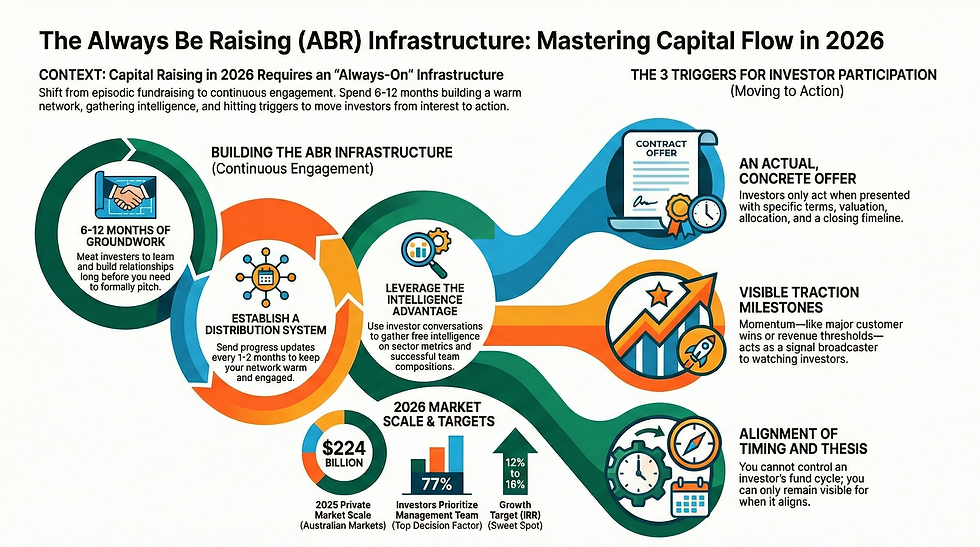
The Australian private market raised $224 billion in 2025. Capital exists. But the signal-to-noise ratio for investors has never been worse. They see hundreds of opportunities. Most get rejected.
According to recent surveys, 77% of investors highlight management team as the primary decision factor. But team assessment includes how founders handle feedback and rejection. Maturity matters as much as experience.
Seed-stage opportunities captured 38% of investor interest. Series A and B rounds remained preferred at 45%. But the companies successfully raising across multiple rounds share a common trait. They treat investor feedback as valuable intelligence rather than personal criticism.
The founders struggling to raise capital often have the same pattern. They pitch. They get rejected. They move on without understanding why. They repeat the same mistakes with the next 50 investors.
The founders raising capital efficiently have a different pattern. They pitch. They get rejected. They extract the reasoning. They adjust their approach. They improve with every conversation.
This is not about changing your business to match every investor's opinion. This is about collecting data points that reveal patterns. When five investors say your valuation is high, it might be high. When three investors question your go-to-market strategy, it might need refinement.
Pattern recognition requires data collection. Rejection feedback is the highest-quality data available in capital raising.
How to Build Rejection Resilience
Next time you get a rejection, try to turn that into something positive by asking the question. Help me understand why.
Frame it clearly. I am not trying to turn you around. I understand you have made your decision. What I want to understand is the mindset you are coming from. What you are seeing. What you are looking at that gave you your thesis to say no.
This feedback loop becomes infrastructure. Not a one-off conversation. A systematic approach to extracting value from every rejection.
The best founders in 2026 are building this into their capital raising process. When they get a no, they have a standard follow-up sequence. A thank you for considering the opportunity. A request for feedback. A note that the relationship remains valuable regardless of investment outcome.
This infrastructure turns rejection from an emotional event into a data collection opportunity. It removes the personal sting because you have a process to follow. It ensures you extract maximum value from every investor conversation.
The founders without this infrastructure take rejection personally. They avoid asking for feedback because it feels like admitting failure. They move on quickly to protect their ego. They lose the most valuable intelligence available.
The Question You Need to Answer
Have you had that experience where an investor said no, gave you the reason, and that turned into valuable advice that changed your trajectory.
If yes, you understand the gift hidden in rejection.
If no, you have been leaving value on the table with every investor conversation.
The difference between efficient capital raising and months of wasted effort often comes down to how you handle rejection. Whether you extract the intelligence. Whether you maintain the relationships. Whether you use the feedback to improve your approach.
Capital raising is not about convincing every investor to say yes. It is about learning fast enough that the right investors eventually say yes.
Rejection is not failure. Rejection without learning is failure.
Build the infrastructure to turn every no into intelligence. Ask the hard questions. Listen with an open mind. Maintain the relationships. Use the feedback to improve your business and your pitch.
This is how founders turn capital raising from a painful process into a strategic advantage. Not by avoiding rejection. By extracting maximum value from it.